What Are the Top Types of Carbon Filters?
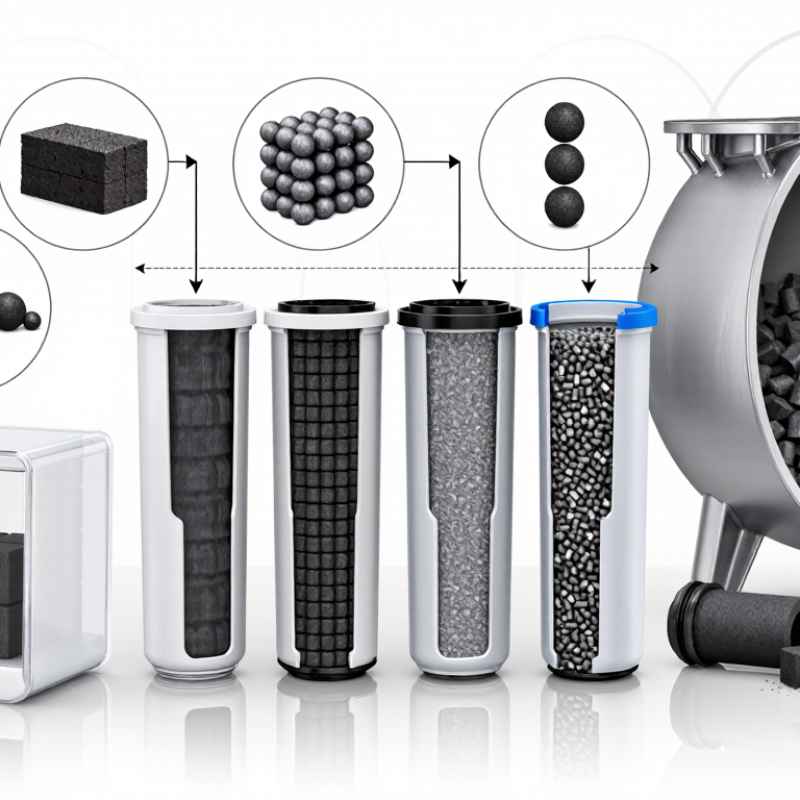
Carbon Filters are often grouped together, yet their media, shape, and performance differ. A faucet cartridge may contain a compact carbon block; an industrial vessel may hold loose granules. Those details affect contact time, pressure drop, and which substances a filter can reduce. Small differences matter.
Grand View Research’s Activated Carbon Market report estimated the global market at about $4.74 billion in 2023. It projected continued growth through 2030, reflecting demand across water treatment, air purification, and other uses. Market growth is useful context, not proof that every carbon filter performs equally. Product claims still need testing against named contaminants and real operating conditions.
The science has deep roots. Chemist Michael Faraday described charcoal’s “power of absorbing gases” in his lecture on the subject. His observation helps explain adsorption, but modern filter design involves much more than charcoal alone. Granular activated carbon, powdered carbon, carbon blocks, catalytic carbon, and impregnated media each serve different purposes. None is a universal fix.
This guide compares the leading types by construction, typical applications, strengths, and limitations. It also looks at practical details: cartridge life, flow rate, and whether the filter is certified for its stated use. A label can sound reassuring. Check the evidence behind it. Even a well-chosen filter may need timely replacement, and real-world water or air conditions can differ from test conditions. That uncertainty deserves attention, not a footnote.
How Carbon Filters Capture Contaminants
Carbon filters capture many dissolved contaminants through adsorption. Molecules cling to the carbon’s porous surface as water flows through it.
The U.S. Environmental Protection Agency’s Engineering Bulletin on granular activated carbon reports typical surface areas of about 500–1,500 square metres per gram. That vast internal area creates many adsorption sites. Micropores matter. But pore size and surface chemistry influence which compounds bind; one carbon type cannot remove everything equally well.
Contact time also counts. Water moving too quickly may leave less time for adsorption, while dissolved organic matter can compete for available sites. The EPA’s 2018 report on PFAS treatment in drinking water notes that granular activated carbon performance depends on the specific compounds and water conditions. Longer-chain PFAS are generally captured more readily than shorter-chain forms.
Carbon-block filters can also physically retain some particles, depending on their construction. A spent filter may release contaminants or simply stop reducing them effectively.
That is the catch.
I would not judge a cartridge by taste alone: many dissolved contaminants have no noticeable smell or flavour. Regular replacement, based on the maker’s schedule and water use, helps keep performance predictable.
Granular Activated Carbon Filters
Granular activated carbon (GAC) filters use small, porous carbon particles to capture many dissolved organic compounds. The U.S. EPA’s 1991 Engineering Bulletin, Granular Activated Carbon Treatment, reports typical surface areas of about 500–1,500 square meters per gram. That enormous internal area helps explain GAC’s usefulness. A handful of grains contains a maze of microscopic pores.
In practice, water flows through a packed bed of GAC, where contaminants attach to the carbon surface. Contact time matters. So do water temperature, competing compounds, and the carbon’s pore structure. EPA’s Drinking Water Treatability Database identifies GAC as a treatment option for various organic contaminants, including certain taste-and-odor compounds. Performance depends on the specific water and operating conditions; a filter should not be assumed to remove every contaminant.
Operators monitor treated water and replace or regenerate carbon when adsorption capacity declines. This is often called breakthrough. It can happen before the media looks different. That part is easy to miss. GAC may also release fine particles after installation, so proper rinsing and routine checks matter. A real system needs testing, not guesswork.
What Are the Top Types of Carbon Filters? — Granular Activated Carbon
Common GAC mesh grades correspond to different particle-size ranges. Smaller mesh numbers indicate larger sieve openings.
The ranges show standard sieve-opening sizes: 8×30 mesh is approximately 0.60–2.36 mm, 12×40 mesh is 0.425–1.70 mm, and 20×50 mesh is 0.30–0.85 mm. Actual product specifications can vary.
Powdered Activated Carbon Filters
Powdered activated carbon (PAC) is a fine, porous material added directly to water to capture taste- and odor-causing compounds and some organic contaminants. Unlike a fixed carbon cartridge, it travels with the water and must later be removed during clarification or filtration. The American Water Works Association’s Water Quality & Treatment handbook describes PAC application rates commonly in the range of about 5–50 mg/L, with the appropriate dose depending on water quality and treatment goals. That range is a starting point, not a recipe.
In practice, operators adjust dosing when seasonal algae or earthy odors appear. A jar test can compare small PAC doses: cloudy water, a measured carbon amount, and a set mixing period. The U.S. EPA’s Drinking Water Treatability Database describes PAC as an adsorbent used within treatment processes, rather than a stand-alone barrier. Contact time and carbon type matter. So does the organic material already in the water, which can compete for adsorption sites. PAC can be useful, but it produces spent solids that need handling. And a dose that works in a test jar may behave differently at plant scale. That deserves a second look.
Carbon Block Filters
Carbon block filters are made by compressing fine activated carbon into a dense, porous cylinder. Water passes through the block, bringing dissolved compounds into contact with carbon surfaces. This can reduce chlorine taste and odor, and some models are tested to reduce specific chemicals. Performance depends on the filter’s design and independent test results.
The dense structure can also trap some particles, such as sediment, though a carbon block is not automatically a complete sediment filter. At a kitchen tap, you may notice a steadier taste and fewer chlorine notes in a glass of water. Flow can be slower than with less dense filters. That trade-off matters. Check the stated flow rate and replacement schedule before choosing one.
Carbon blocks do not remove every contaminant, and they should not be treated as disinfection devices. Look for documentation that identifies the exact substances tested and the conditions used. A filter past its service life may perform poorly, even if the water still looks clear. I’d also pay attention to pressure changes: a gradual slowdown can suggest clogging, but it is not a precise measure of contaminant removal. Not always obvious. That is worth remembering.
What Are the Top Types of Carbon Filters? – Carbon Block Filters
| Filter Type | How It Is Made | Common Uses | Key Advantages | Considerations |
|---|---|---|---|---|
| Carbon Block | Fine activated-carbon particles are compressed and held together with a binder to form a solid block. | Point-of-use drinking-water systems, refrigerator filters, and under-sink cartridges. | Provides substantial contact between water and carbon. Depending on its design and rated pore size, it may also reduce some suspended particles. | Flow rate and pressure drop depend on block density, dimensions, and pore rating. It does not remove every contaminant; check performance claims for the specific cartridge. |
| Granular Activated Carbon (GAC) | Loose activated-carbon granules are contained in a cartridge or treatment vessel. | Water-filter pitchers, countertop systems, and larger treatment vessels. | Water passes through a bed of granules that can adsorb certain dissolved compounds, including chlorine-related taste and odor compounds. | Performance depends on contact time and water conditions. Poorly designed or exhausted beds can allow water to bypass the media. |
| Catalytic Carbon | Activated carbon is processed to improve catalytic activity for selected reactions. | Specialized water treatment, including systems designed to address chloramine under specified operating conditions. | Can be more effective than standard activated carbon for certain treatment goals when the system provides adequate contact time. | Results depend on the media, flow rate, water chemistry, and system design. Verify the tested reduction claims for the intended contaminant. |
| Impregnated Activated Carbon | Activated carbon is treated with an added substance to target particular compounds or treatment needs. | Specialized air or water applications where a standard carbon surface alone may not provide the desired treatment. | The added treatment can support removal or control of selected contaminants beyond the media’s general adsorption function. | There is no single performance profile for this category. The impregnant, application, and approved use must be checked carefully. |
| Activated Carbon Fiber or Cloth | Activated carbon is formed into a fibrous or cloth-like material rather than loose granules or a conventional block. | Specialized compact filters and certain air-treatment applications. | The thin, porous structure can offer accessible adsorption surfaces in a compact format. | Capacity, service life, and contaminant performance vary by material and construction; these products are not interchangeable with standard carbon cartridges. |
Selection note: Carbon-filter performance varies by media, cartridge design, flow rate, contact time, and water quality. For drinking-water treatment, look for independently verified claims that name the specific contaminant and match the intended use.
Specialty and Impregnated Carbon Filters
Specialty carbon filters are designed for particular air or water treatment needs, rather than broad odor reduction alone. Their carbon may have a selected pore structure or a surface modified to capture specific compounds. A filter used near a solvent odor, for example, may need different media from one treating chlorine in water. The target contaminant matters.
Impregnated carbon contains added chemicals that can react with or bind certain gases. This can help capture substances that ordinary adsorption handles poorly. But performance depends on the contaminant, airflow, humidity, and contact time. A thin carbon layer pushed by fast-moving air may not work as expected. Details matter.
In practice, choosing a specialty filter is less tidy than a product label suggests. Check the tested contaminants, operating conditions, and replacement guidance. For water systems, confirm that the filter is suitable for the specific water quality and intended use. A damp room or changing air mixture can shorten service life. I would not assume that “specialty” means universal protection; the test data should match the actual problem.