Top 10 Steel Pipe Making Machine Manufacturers
Choosing a Steel Pipe Making Machine manufacturer is a practical decision with long-term consequences. The right line must match the required pipe diameter, wall thickness, steel grade, and production volume. It also needs dependable forming, welding, sizing, and cutting equipment. On a factory floor, small details matter: stable roll alignment, accessible controls, and quick access to service parts can affect daily output. A polished brochure is not enough.
W. Edwards Deming, a renowned manufacturing-quality expert, wrote, “Quality comes not from inspection, but from improvement of the production process.” That principle offers a useful lens for comparing machine manufacturers. Look beyond headline speed. Ask how each supplier verifies weld consistency, supports commissioning, trains operators, and responds when a line stops. Request references from plants making similar products, and check what is included in the quoted configuration. Details can hide in the fine print. No ranking is perfect.
This guide presents ten Steel Pipe Making Machine manufacturers and the strengths buyers may want to investigate. Some focus on complete production lines; others may offer particular forming or finishing technologies. Compare specifications against your actual production needs, not an idealized target. A machine that performs well in one plant may not suit another. Even a careful shortlist has limits: supplier claims should be checked against documented tests, service terms, and real operating conditions.
Steel Pipe Making Machines: Scope and Core Functions
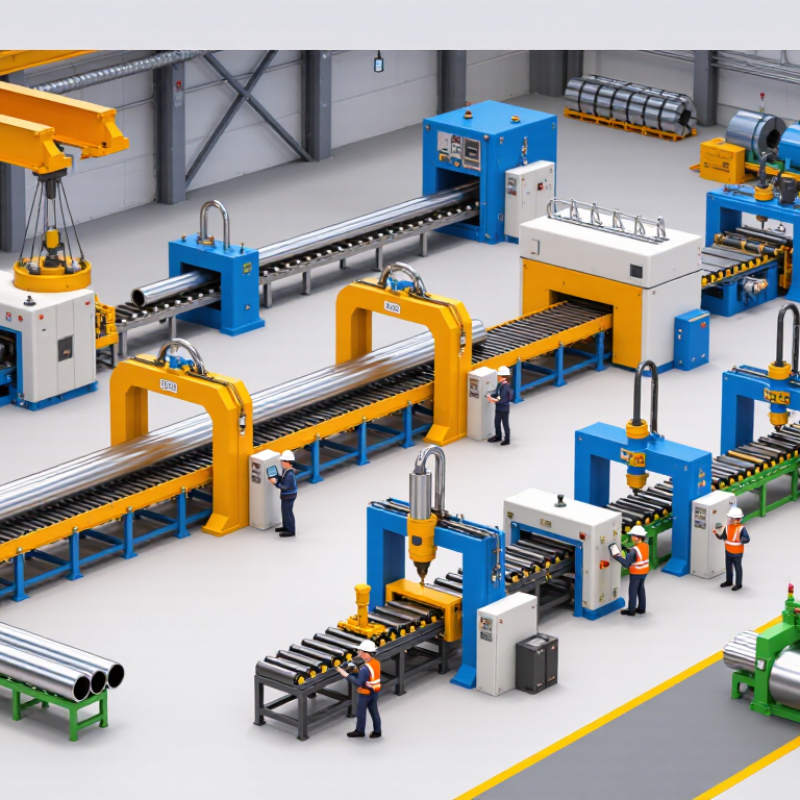
Steel pipe making machines cover a connected production line, not one forming press. A welded-pipe line may include coil handling, edge trimming, strip forming, welding, sizing, cutting, and inspection. Each stage controls a different risk: poor edge alignment can weaken a weld, while inaccurate sizing affects fit-up at installation. For electric-resistance-welded pipe, operators monitor weld heat, pressure, and line speed. Small changes matter.
The World Steel Association reported 1,892.2 million tonnes of crude steel production worldwide in 2023 in World Steel in Figures 2024. This scale helps explain the need for stable, repeatable processing, though crude steel output is not a measure of pipe-machine demand. A typical mill also uses sensors and control systems to track dimensions and production settings. Cut-to-length saws or flying saws keep pace with the moving tube. Testing may include visual checks and nondestructive inspection, depending on product requirements.
Seamless pipe uses a different route, typically involving billet heating and piercing, so its equipment should not be confused with welded-tube mills. Buyers should match machine capacity to pipe diameter, wall thickness, steel grade, and target output. The fastest line is not always the best fit. Maintenance access and changeover time deserve attention too; these details are easy to underestimate in a specification sheet.
How Steel Pipe Production Lines Work
Top 10 Steel Pipe Making Machine Manufacturers
How Steel Pipe Production Lines Work
A typical electric-resistance-welded (ERW) pipe line starts with a steel coil. An uncoiler feeds the strip through leveling rolls, which flatten it before forming rolls bend it into a tube. High-frequency current heats the meeting edges, and pressure joins them into a continuous seam. A scraper removes excess weld metal; sizing rolls then bring the pipe to its target diameter. The line cuts it to length. Small errors travel.
Inspection matters as much as forming. Operators may use ultrasonic or eddy-current testing to check the weld, followed by dimensional checks and, where specified, hydrostatic testing. The World Steel Association’s World Steel in Figures 2024 reports 1,892.2 million tonnes of global crude steel production in 2023. That figure describes upstream steel output, not pipe production, but it shows the scale of the material supply behind these lines. A glossy seam alone proves little.
Tips: Match roll tooling to the required diameter and wall thickness, and monitor weld temperature and line speed together. Keep test records tied to each pipe batch. One practical caution: settings that work for one steel grade may not transfer cleanly to another, so verify them during a controlled trial.
How a Typical Steel Pipe Production Line Works
A simplified sequence of common operations in an electric resistance welded (ERW) pipe line. Actual equipment layouts and process steps vary by product and manufacturer.
The vertical values show operation order only—not production speed, processing time, or machine performance. Inspection may include dimensional checks and, where specified, non-destructive or pressure testing.
Key Criteria for Comparing Machine Manufacturers
Compare steel pipe machine manufacturers against the pipe you will actually produce, not the widest range in a brochure. The World Steel Association reported 1,892.2 million tonnes of crude steel production in 2023, reflecting the scale of the industry, though not demand for any single pipe line. Ask each supplier for documented output rates using your material grade, wall thickness, diameter, and target tolerances. Request weld samples and inspect bead consistency, cut ends, and dimensional results. A fast machine means little if setup changes create scrap. Check whether quoted speeds include changeovers and routine stops.
Reliability depends on more than the forming line. Ask for a factory acceptance test, commissioning plan, operator training, and a clear list of recommended spares. Verify service response times and whether critical components are available locally. Energy use deserves attention: the International Energy Agency identifies industry as a major share of global energy consumption, so compare measured consumption per tonne, not motor ratings alone. Request references from plants with similar products and shift patterns. No report replaces a site visit. One uncomfortable question helps: what happens when the line misses its promised output? Answers should include operating conditions, exclusions, and measurable remedies—not just a polished forecast.
Profiles of Ten Steel Pipe Making Machine Manufacturers
Across ten steel pipe making machine manufacturer profiles, the most useful differences appear on the factory floor. Some suppliers focus on high-speed ERW lines; others specialize in spiral forming, heavy-wall pipe, or downstream sizing and finishing. Compare forming accuracy, weld monitoring, changeover time, and access to replacement rolls. A polished brochure cannot show how quickly a crew can correct a drifting seam. Details matter. Ask for production data using your steel grade, wall thickness, and target diameter—not just an ideal test coil.
The World Steel Association’s World Steel in Figures 2024 reports 1,888.2 million tonnes of crude steel production in 2023, underscoring the scale of the industrial base these lines serve. The International Energy Agency’s Iron and Steel Technology Roadmap notes that steelmaking contributes roughly 7% of global energy-related carbon dioxide emissions. That makes motor efficiency, scrap control, and stable weld quality practical considerations, not decorative claims. In each profile, look for commissioning support, operator training, and documented uptime under comparable conditions. One weakness in many comparisons: “maximum speed” often gets more attention than yield, maintenance hours, or real changeover performance. A slower line may prove more dependable.
Top 10 Steel Pipe Making Machine Manufacturers - Profiles of Ten Steel Pipe Making Machine Manufacturers
The profiles below describe ten common equipment-specialist categories in the steel pipe machinery industry. They are not named companies or a ranked list of verified manufacturers; capabilities vary by supplier and project specification.
| Profile | Typical Equipment Focus | Forming or Production Process | Common Product Scope | Relevant Standards (Where Specified) |
|---|---|---|---|---|
| Profile 1: ERW Mill Specialist | Coil handling, strip forming, high-frequency welding, sizing, cutting, and inspection equipment | Electric resistance welding (ERW) | Welded carbon-steel pipe and tube; available size ranges depend on the mill design | API 5L, ASTM A53, or ASTM A500 may be specified for the finished product |
| Profile 2: Small-Diameter Tube Line Specialist | Compact roll-forming mills, precision sizing stands, flying saws, and tube-end equipment | Continuous forming and ERW production | Small-diameter round, square, and rectangular tube | ASTM A500 may apply to structural tubing when the product and order meet its requirements |
| Profile 3: Large-Diameter Spiral Pipe Line Specialist | Uncoiling, edge preparation, spiral forming, welding, cutting, and pipe handling systems | Submerged arc welded (SAW) spiral production | Large-diameter welded pipe formed from steel strip or coil | API 5L or ISO 3183 may be specified for line pipe, subject to product requirements |
| Profile 4: Longitudinal SAW Line Specialist | Plate preparation, forming presses, longitudinal seam welding, expansion, and inspection equipment | Longitudinal submerged arc welding (LSAW) | Large-diameter pipe made from formed steel plate | API 5L or ISO 3183 may be specified for line pipe, subject to the applicable edition and order |
| Profile 5: Pipe Mill Automation Specialist | Mill control systems, drives, sensors, process monitoring, and production data integration | Automation for ERW, spiral, or longitudinal welded pipe lines | Controls and upgrades for pipe-forming and finishing operations | Finished-product standards are determined by the pipe producer and purchase specification |
| Profile 6: Pipe Welding Equipment Specialist | High-frequency welders, SAW power sources, welding heads, and associated process controls | Welding systems for longitudinal or spiral welded pipe production | Welding equipment configured for a specified mill and pipe product | Welding procedure and acceptance requirements depend on the applicable product specification |
| Profile 7: Sizing and Finishing Line Specialist | Sizing stands, straighteners, end-facing machines, beveling units, and handling systems | Post-forming calibration and finishing | Dimensionally finished welded pipe and tube | Dimensional tolerances and end-finish requirements are set by the product standard and purchase order |
| Profile 8: Pipe Inspection and Testing Equipment Specialist | Ultrasonic, electromagnetic, hydrostatic testing, and dimensional inspection systems | In-line or offline quality inspection and testing | Inspection equipment for welded pipe production and quality control | Test methods and acceptance criteria depend on the applicable standard and product specification |
| Profile 9: Pipe Coating Line Specialist | Surface preparation, heating, coating application, curing, and coating inspection equipment | External or internal pipe coating processes | Coated pipe for specified service environments | Coating requirements are selected for the application; they are separate from the base-pipe product standard |
| Profile 10: Seamless Pipe Equipment Specialist | Billet heating, piercing, rolling, sizing, and finishing equipment for seamless production | Hot working of solid steel billets without a welded seam | Seamless steel pipe, with dimensions and grades dependent on the production line | ASTM A53 includes seamless pipe options; the applicable grade and requirements must be confirmed in the order |
Standards listed are examples of commonly referenced product specifications, not a claim that any particular equipment supplier or production line is certified to them. Confirm mill capacity, product range, and compliance requirements directly against the project specification.
Matching a Manufacturer to Production Requirements
A steel pipe making machine should fit the products you plan to sell, not just the capacity listed in a brochure. Define pipe diameter, wall thickness, steel grade, and tolerance range before comparing manufacturers. Start with the pipe. A line designed for frequent changes in diameter may need different tooling and setup features than one running a single size for long shifts. Ask how long a typical changeover takes, and what operators must adjust by hand.
Production speed matters, but only alongside stable weld quality and dependable material feeding. Request data for a product close to your actual specification, rather than relying on maximum-speed claims. Ask to see how the manufacturer checks forming accuracy, weld consistency, and finished dimensions. A test run using your sample material can expose practical issues, such as edge variation or extra adjustment time. Small details count.
Service is part of the machine’s fit. Confirm which wear parts are stocked, how technicians handle commissioning, and what training operators receive. Compare quotations using the same scope: tooling, controls, installation, and documentation. A low purchase price may leave essential items unclear. One caveat: no supplier can remove every production risk. Share your real operating schedule and future product plans, then ask where the proposed line may fall short. A candid answer is useful evidence.