What Is PET Polyester Film Used For?
PET Polyester Film appears in more products than many buyers realize. It can sit inside a snack wrapper, protect a printed label, or separate layers in an electrical component. Its value comes from controlled thickness, strong tensile performance, dimensional stability, and a clean surface.
Dr. George Wypych, a recognized polymer-materials specialist, states, “Film performance depends on its structure, processing, and end use.” That principle guides responsible material selection. A packaging converter may choose transparent, heat-stabilized PET film for product visibility. An electronics manufacturer may require thin film with dependable dielectric strength. Graphic producers often prefer a smooth surface that accepts inks, adhesives, and protective coatings.
Small details matter.
Biaxial orientation improves strength in two directions. Coatings can increase barrier performance, slip, or printability. However, PET Polyester Film is not a universal solution. A grade that performs well in flexible packaging may behave poorly under intense heat, sharp bending, or prolonged outdoor exposure. Adhesive choice also matters. Poor lamination can create bubbles, curling, or delamination after storage.
The most reliable decision considers the full service environment. Engineers should review thickness tolerance, thermal shrinkage, moisture exposure, surface treatment, and intended recycling route. Laboratory testing remains necessary because catalog data cannot represent every converting line or climate.
There is an uncomfortable limitation. Multilayer structures can improve product protection while making recovery more difficult. Therefore, the best use of PET Polyester Film balances durability, manufacturing efficiency, safety, and end-of-life planning. Its future depends not only on performance, but also on more thoughtful design.
Definition and Basic Properties of PET Polyester Film
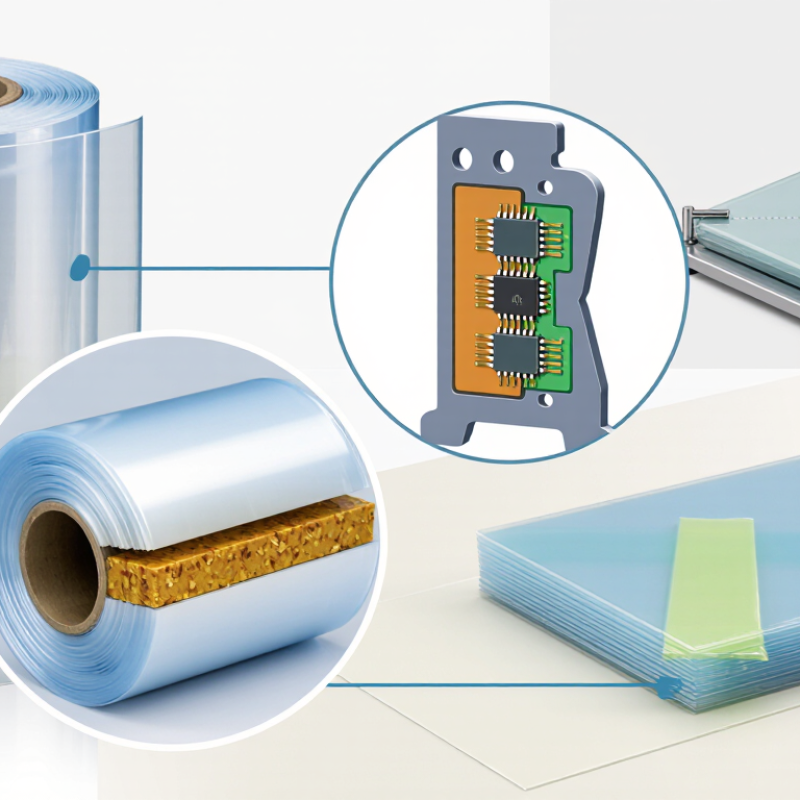
PET polyester film is a thin, flexible sheet made from polyethylene terephthalate, commonly called PET. Manufacturers usually stretch it in two directions during production. This process improves strength, clarity, and dimensional stability. The result is a film that feels light but resists tearing under normal handling.
Its properties explain its wide use. PET film offers good tensile strength, smooth surfaces, and reliable insulation. It also tolerates moderate heat and many oils, solvents, and chemicals. Electrical components may use it as an insulating layer. Packaging, labels, graphics, release liners, and protective covers also depend on its clean appearance. Thickness can range from very thin technical grades to heavier sheets. Surface treatments may improve printing, adhesion, or anti-static performance.
In practical work, PET film is easy to handle, but it is not perfect. It can crease permanently when sharply folded. Moisture resistance is useful, yet moisture and heat can still affect processing accuracy. Clear film may reveal scratches that are invisible on a matte surface. Selection should consider temperature, thickness, surface energy, and end-use stress. Recyclability also depends on coatings, laminations, inks, and local collection systems. A film that performs well in a laboratory may behave differently on a fast production line. Testing remains necessary.
How PET Polyester Film Is Manufactured
What Is PET Polyester Film Used For?
PET polyester film begins as a carefully controlled polymer resin. Manufacturers combine purified terephthalic acid with ethylene glycol. Heat drives a reaction that forms long polyester chains. The molten material then passes through a flat die, creating a thin, continuous sheet.
The sheet is stretched in two directions. This biaxial orientation improves strength, clarity, and dimensional stability. Heat setting follows. It reduces internal stress and helps the film keep its shape during later use. Depending on the application, manufacturers may add coatings for printing, insulation, sealing, or better surface adhesion. The finished film is wound into large rolls, then slit into narrower widths.
The process is precise, but not flawless. A slight temperature change can affect thickness or transparency. Dust, uneven stretching, and moisture may also create weak points.
Quality teams check samples for tensile strength, haze, thickness, and surface energy. These tests support reliable use in packaging, electrical insulation, labels, release liners, and protective layers. However, test results do not always predict every converting problem.
Tips: Store PET film in a clean, dry area. Allow it to reach room temperature before processing. Check roll edges and surface condition first. Small handling errors can become visible during printing or lamination.
Key Types and Performance Characteristics
What Is PET Polyester Film Used For?
PET polyester film supports packaging, electronics, labels, insulation, and industrial laminates. Its most common form is biaxially oriented PET, or BOPET. Stretching the film in two directions improves tensile strength, clarity, and dimensional stability. Smithers’ market study, The Future of BOPET Films to 2028, places annual global BOPET demand above four million tonnes. Packaging remains a major application, while electrical and technical uses demand tighter specifications.
Key types differ by surface and function. Transparent PET film offers clarity and stable thickness for labels and windows. Metallized PET reflects light and improves oxygen and moisture resistance in flexible packaging. Coated grades support printing, adhesion, or heat sealing. Electrical grades require controlled dielectric strength, low shrinkage, and clean surfaces. ASTM D882 is commonly used for tensile testing, while ASTM D1003 measures haze and light transmission. These tests expose weaknesses that product brochures may hide.
Tips: Match film properties to the converting process. Check thickness tolerance, shrinkage, surface treatment, and coefficient of friction. For food-contact packaging, verify the applicable regional requirements and migration data. Do not select film by tensile strength alone. A stiff film may crack during folding. A clear film may haze after coating. I have seen specifications fail because humidity was ignored. That detail matters. Smithers also notes growing demand for thinner, higher-performance films, but thinner does not always mean better. Converters should test real laminates, heat, ink, and storage conditions before approval.
What Is PET Polyester Film Used For?
Representative PET film thicknesses used across major applications. Actual specifications vary by grade, coating, orientation, and end-use requirements.
Thin PET films are common in flexible packaging, labels, and release liners because they provide clarity, dimensional stability, and moisture resistance. Thicker films are typically selected for electrical insulation, graphics, and solar backsheet structures where higher mechanical strength and durability are required.
Common Industrial and Commercial Applications
PET polyester film is a thin, strong material used across many industrial and commercial applications. In flexible packaging, manufacturers use it as a protective layer for pouches, lidding films, snack wrappers, and pharmaceutical packs. Its resistance to moisture, oils, and moderate heat helps protect printed graphics and sensitive contents. Smithers’ 2024 polyester film market review identifies packaging as the largest demand area, supported by growing needs for lightweight and high-barrier structures.
Electrical insulation is another major application. PET film separates layers in motors, transformers, cables, and flexible circuits. Its stable thickness and dielectric strength support reliable performance in narrow spaces. Electronics manufacturers also use it for display components, membrane switches, labels, and insulation tapes. Small tolerances matter here. A slight thickness variation can affect assembly quality.
PET film also appears in solar backsheets, decorative laminates, release liners, and industrial masking materials. The Fraunhofer Institute’s Photovoltaics Report 2024 recorded global photovoltaic capacity above 1.6 terawatts, creating continued demand for durable polymer components. However, PET film is not automatically sustainable. Recycling can be difficult when it is laminated with adhesives, inks, aluminum, or other polymers. That assumption needs checking. Design choices, collection systems, and end-of-life separation often determine its real environmental value.
Factors for Selecting PET Polyester Film
What Is PET Polyester Film Used For?
PET polyester film appears in flexible packaging, electrical insulation, labels, solar modules, release liners, and protective overlays. Its strength, dimensional stability, and transparency make it useful where thin materials must survive tension and heat. A 2024 market assessment reports that the global polyester film market reached approximately USD 40 billion in 2023, with steady growth expected through 2030. Demand is rising, but performance still depends on selecting the correct grade.
Factors for Selecting PET Polyester Film
Start with the working environment. For packaging, check oxygen and moisture barriers, sealing temperature, print adhesion, and puncture resistance. For electrical applications, review dielectric strength, thickness tolerance, and thermal endurance. Outdoor products need ultraviolet resistance and low shrinkage. A film that looks clear in the sample room may haze after lamination. That is often overlooked.
Tips: Compare the technical data sheet with real production conditions. Test rolls at actual line speed, temperature, and humidity. Measure shrinkage, coefficient of friction, haze, tensile strength, and adhesion. The International Organization for Standardization identifies PET film dimensions and test methods through relevant packaging and plastic-film standards, helping buyers compare results consistently. However, standards do not replace testing. A lower-cost film can create more waste through curling, blocking, or unstable registration. Some selection decisions remain imperfect; supplier data may use different test conditions, so independent verification is worth the extra time.
What Is PET Polyester Film Used For? - Factors for Selecting PET Polyester Film
| Application | Primary Function | Recommended Film Characteristics | Typical Thickness Range | Important Selection Factors |
|---|---|---|---|---|
| Flexible Packaging | Provides a printable, stable substrate and can be laminated with sealant or barrier layers. | Clear or metallized, corona-treated, low-odor, and compatible with adhesives and inks. | 8–25 µm for many laminated structures | Optical clarity, coefficient of friction, heat resistance, print adhesion, oxygen and moisture barrier requirements, and food-contact compliance where applicable. |
| Labels and Decorative Graphics | Offers a smooth, dimensionally stable surface for high-quality printing and durable identification. | Gloss, matte, or white surface; printable coating; strong tear and chemical resistance. | 12–50 µm for label facestocks; thicker grades for durable graphics | Surface energy, ink compatibility, adhesive anchorage, outdoor exposure, dimensional accuracy, and resistance to abrasion and cleaning chemicals. |
| Electrical Insulation | Insulates wires, coils, motors, transformers, and other electrical components. | High dielectric strength, uniform thickness, clean surface, and suitable thermal classification. | 25–250 µm, depending on insulation design | Dielectric strength, insulation resistance, partial-discharge performance, temperature rating, edge quality, and applicable electrical standards. |
| Industrial Laminates and Release Liners | Acts as a carrier, processing substrate, or controlled-release surface for adhesives and composite materials. | Smooth, dimensionally stable, heat-resistant, and coated with a controlled-release treatment when required. | 25–125 µm for many converting processes | Release force, coating uniformity, tensile strength, web handling, surface smoothness, and compatibility with curing temperatures. |
| Solar and Energy Components | Provides electrical insulation, mechanical support, or a protective layer in multilayer energy assemblies. | Hydrolysis-resistant, low-shrinkage, electrically insulating, and suitable for lamination. | Typical designs use approximately 25–250 µm | Long-term humidity resistance, ultraviolet exposure, dielectric properties, thermal cycling, adhesion, and dimensional stability. |
| Magnetic, Imaging, and Recording Media | Supplies a smooth, strong, and dimensionally stable base for functional coatings. | Very smooth surface, low particulate level, high tensile strength, and precise thickness control. | 12–50 µm for many precision-coated products | Surface roughness, coating adhesion, cleanliness, winding performance, thickness tolerance, and dimensional stability. |
| Construction and Window Films | Functions as a carrier for solar-control, safety, decorative, or scratch-resistant coatings. | Optically clear, UV-stabilized, low-haze, and compatible with pressure-sensitive adhesives. | 25–125 µm for many architectural film structures | Visible-light transmission, haze, ultraviolet stability, shrinkage, weatherability, adhesion, and installation requirements. |
- Film thickness and tolerance: Select the minimum thickness that meets mechanical, electrical, and processing requirements.
- Surface treatment: Choose untreated, corona-treated, coated, or primed film according to the ink, adhesive, or coating system.
- Mechanical performance: Review tensile strength, elongation, tear resistance, puncture resistance, and web-handling behavior.
- Thermal performance: Consider the continuous operating temperature, processing temperature, heat shrinkage, and dimensional stability.
- Optical properties: For transparent applications, compare clarity, gloss, haze, and color consistency.
- Environmental resistance: Check resistance to moisture, chemicals, ultraviolet radiation, hydrolysis, and repeated temperature changes.
- Compliance and sustainability: Confirm the required regulatory approvals, recyclability objectives, and compatibility with the intended end use.
Note: Thickness ranges and performance requirements are typical industry guidelines. The appropriate PET film grade should be validated through application testing and the relevant technical standards.