China Top Brass Pipe Manufacturers and Suppliers?
China’s Brass Pipe industry serves plumbing, HVAC, marine, and industrial buyers with products ranging from straight tubes to custom-drawn profiles. Brass Pipe selection depends on more than price. Alloy grade, wall thickness, dimensional tolerance, corrosion performance, and documentation all affect service life and installation quality. A tube that looks clean under warehouse lights may still fail a pressure test if its wall thickness varies.
Industry figures offer useful context, but they need careful interpretation. The International Copper Study Group’s World Copper Factbook 2024 reports global refined copper usage of about 26 million tonnes in 2023. This is not a brass-pipe market estimate; it indicates the scale of copper demand supporting downstream manufacturing. Brass combines copper with zinc, so alloy composition and processing can change its strength, machinability, and corrosion behavior. Small differences matter.
This guide examines leading Chinese manufacturers and suppliers through practical checks: published specifications, production capabilities, inspection records, export experience, and responsiveness to technical questions. Buyers should request material certificates and clarify applicable test methods before comparing quotations. Ask how suppliers control dimensions and verify pressure or leak performance. A polished catalog is not proof. Supplier claims should be checked against samples, records, and independent inspection where appropriate. No single supplier fits every project, and public information can be incomplete. That is worth admitting.
What Brass Pipes Are and Where They Are Used
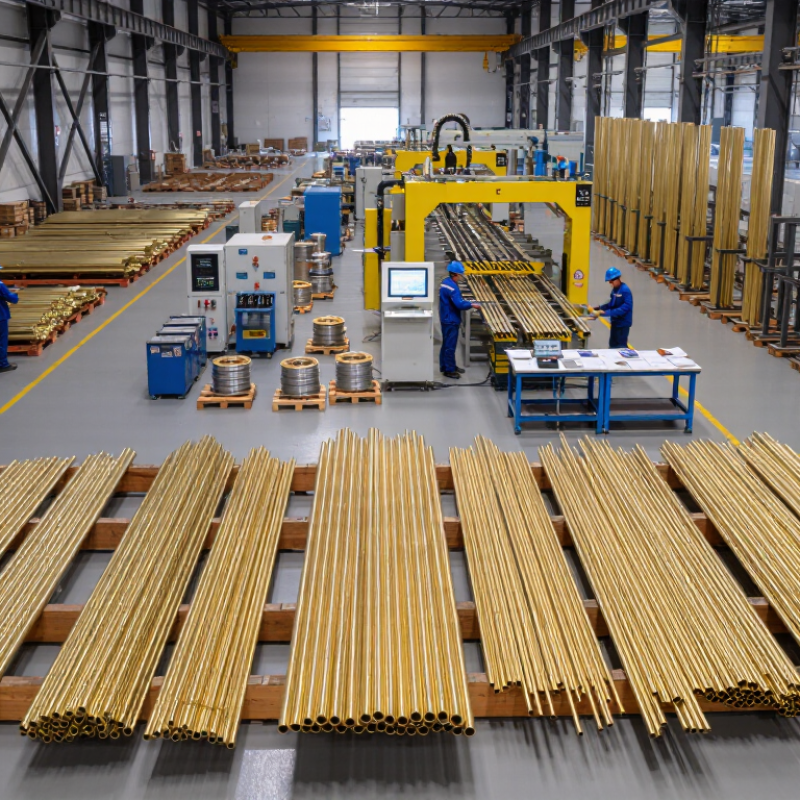
Brass pipe is made from copper-zinc alloy, with proportions adjusted to balance strength, machinability, and corrosion resistance. It is often selected for fittings and fluid lines where dependable shaping matters. The material’s warm gold color is familiar, but appearance alone says little about suitability. Alloy grade, wall thickness, water chemistry, and operating temperature all matter.
Common applications include plumbing connections, heating and cooling systems, compressed-air lines, and marine components. In a workshop, brass pipe can be cut and joined into compact assemblies; in service, it may carry water or other compatible fluids. Not every brass grade suits every medium. Ammonia-containing environments, for example, can damage some copper alloys, so engineers should check compatibility data rather than rely on a generic description.
Industry figures provide useful context, not a direct measure of brass-pipe demand. The US Geological Survey’s Mineral Commodity Summaries 2025 estimated global refined copper production at about 27 million metric tons in 2024. Brass is only one of many copper-alloy uses, so that total should not be mistaken for pipe production. For product selection, ASTM B43 covers seamless red brass pipe dimensions and requirements; buyers should also request the actual alloy designation and test documentation. A small detail, but an important one.
China Top Brass Pipe Manufacturers and Suppliers? - What Brass Pipes Are and Where They Are Used
| Category | Typical Material or Standard | Common Uses | Buyer Considerations |
|---|---|---|---|
| What brass pipe is | A hollow product made from copper-zinc alloy. Trade usage sometimes distinguishes “pipe” by nominal size and “tube” by exact outside diameter, but terminology varies by market and standard. | Water and plumbing systems, heat-transfer equipment, marine components, and general engineering. | Confirm the product’s dimensions, alloy, temper, manufacturing method, and applicable specification rather than relying on the name alone. |
| General-purpose Brass Tube | Brass grades vary in copper and zinc content. ASTM B135 covers seamless brass tube; ASTM B251 sets general requirements for wrought seamless copper-alloy tube. | Fabricated components, fittings, decorative work, and selected fluid or mechanical applications. | Check whether the chosen grade and dimensions are covered by the specified standard and are suitable for the intended service. |
| Condenser and heat-exchanger tube | ASTM B111/B111M covers copper and copper-alloy condenser tubes and ferrule stock. Copper-zinc alloys used for this service include admiralty brass and aluminum brass grades. | Condensers, heat exchangers, and related equipment where heat transfer and fluid compatibility matter. | Specify the exact alloy, tube dimensions, end condition, and operating environment; seawater chemistry and flow conditions affect material selection. |
| Admiralty brass | A copper-zinc alloy family commonly modified with tin; C44300 is a recognized admiralty brass designation. | Condenser and heat-exchanger tubing in some water-service applications. | Verify the required grade and standard, and assess corrosion risks for the actual water, temperature, and operating conditions. |
| Aluminum brass | A copper-zinc alloy containing aluminum; C68700 is a commonly referenced aluminum brass grade. | Some condenser, heat-exchanger, and marine-service tubing applications. | Confirm compatibility with the service environment and any project-specific requirements; no alloy is suitable for every water condition. |
| Plumbing and building services | Brass tube or pipe selected to meet the applicable local plumbing code, product standard, and potable-water requirements. | Water distribution and building-service installations where permitted by local regulations. | Check local approvals, lead-content rules, pressure and temperature ratings, joining method, and compatibility with fittings. |
| Marine and industrial service | Alloy selection depends on the fluid, salinity, temperature, flow velocity, and exposure conditions. | Selected seawater circuits, equipment tubing, and industrial heat-transfer systems. | Request documented alloy and test records, and obtain engineering review for corrosion, erosion, and pressure requirements. |
| Supplier evaluation in China | Compare suppliers by verified production capability, quality system, traceability, and ability to meet the required specification. | Domestic projects and export orders requiring brass tube or pipe in specified sizes and grades. | Request a material test certificate, dimensional inspection results, applicable standard and edition, sample approval, packaging details, and independent inspection when needed. |
Note: Alloy names and standards identify material or product requirements, not universal service ratings. Confirm the current standard edition, governing code, and suitability with the project engineer before ordering or installation.