China Best Commercial Flood Lights for Global Buyers?
Commercial Flood Lights are no longer judged by brightness alone. Global buyers also compare energy use, beam control, durability, and documented performance. The International Energy Agency has estimated that lighting accounts for roughly 15% of global electricity consumption. That figure helps explain why efficient fixtures matter, though a floodlight’s real savings depend on its design and operating hours.
China offers a broad supplier base, from high-output fixtures for ports and sports grounds to compact models for loading bays. Yet a large lumen figure does not prove good site coverage. Buyers should check efficacy, beam angle, color temperature, ingress protection, surge protection, and thermal-management details. Ask for photometric files and test reports tied to the exact model—not a similar-looking product. Small details count. A poorly aimed fitting can send light beyond the work area, while weak heat control may shorten service life.
The U.S. Department of Energy reports that LED products use at least 75% less energy and can last up to 25 times longer than incandescent lighting. These are broad technology comparisons, not a guarantee for every Commercial Floodlight. For a fair supplier comparison, review the datasheet, warranty terms, sample quality, and consistency between samples and production units. Independent testing can add confidence, but paperwork still needs careful checking. That part is easy to overlook. This guide examines how global buyers can assess China-made Commercial Flood Lights with practical evidence, realistic expectations, and attention to the conditions where each fixture will operate.
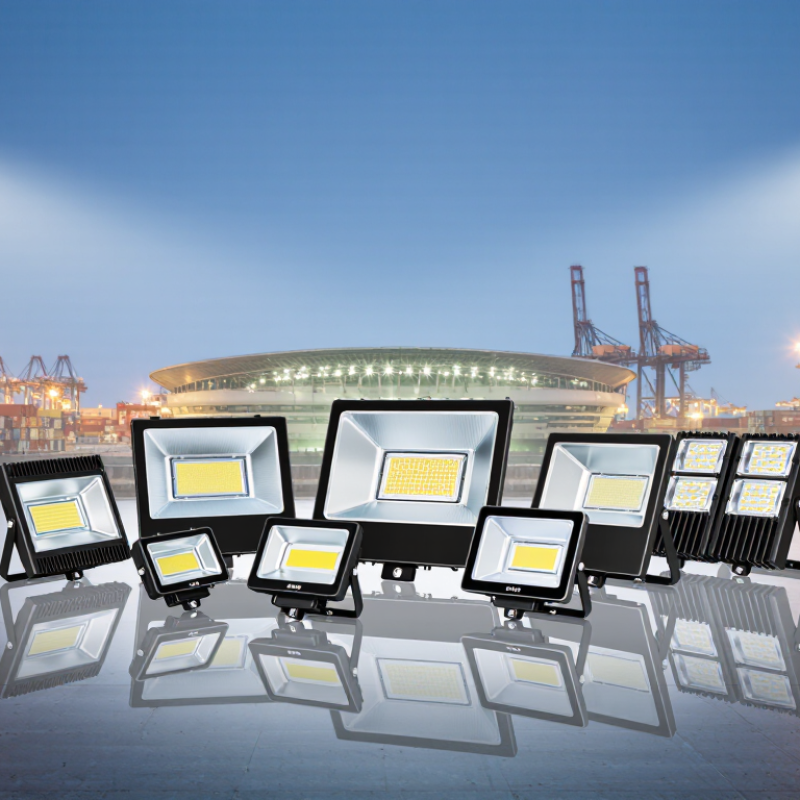
What Commercial Flood Lights Are and How They Work
Commercial flood lights are broad-beam luminaires designed to illuminate outdoor areas such as loading bays, car parks, and building façades. In an LED unit, semiconductor chips produce light when an electrical current passes through them. A driver regulates that current, while reflectors or lenses shape the beam. The heat sink draws warmth away from the chips; poor heat management can shorten service life. Some models also use photocells or motion sensors.
Performance depends on more than wattage. Buyers should compare lumen output, efficacy, beam angle, colour temperature, and ingress protection ratings against the installation environment. The U.S. Department of Energy’s Energy Saver guidance says LEDs use at least 75% less energy and can last up to 25 times longer than incandescent lighting. These are broad comparisons, not guaranteed savings for every project. Actual results depend on operating hours, controls, product quality, and maintenance. A missed detail—such as mounting height—can leave dark patches despite a high lumen rating.
Tips: Check the beam layout before ordering. Test a sample at the intended mounting height, and look for glare on nearby windows or roads. Keep the lens and heat sink accessible for cleaning; dust and blocked airflow can reduce useful performance. A site check may reveal something the specification sheet does not.
Main Types of Commercial Flood Lights Made in China
Commercial flood lights made in China generally fall into several practical types. LED floodlights are the standard choice for warehouses, loading bays, and building exteriors. They offer directional output and can be specified with different beam angles, color temperatures, and mounting brackets. The U.S. Department of Energy’s 2020 Lighting Market Characterization reported that LEDs represented 48% of installed lighting in the United States. That figure is not a global forecast, but it shows how widely the technology has moved into everyday use.
Solar floodlights combine a panel, battery, and fixture, making them useful where wiring is difficult. Their real performance depends on sunlight, battery capacity, and operating hours—not just the advertised wattage. High-mast floodlights serve ports, yards, and large parking areas, where optics and pole height matter as much as lumen output. For façades, sports venues, or landscape features, RGB or tunable-color models provide adjustable effects. They need careful controls, though.
Buyers should compare delivered lumens, efficacy, ingress protection, surge protection, and test reports for the complete fixture. A high IP rating helps resist dust and water, but it does not prove long-term durability. Ask for photometric files and independent test documentation. Check the driver and heat-sink design, too. Small details count. One weakness in many product listings is unclear test conditions; request the operating temperature and measurement method before comparing models.
Main Types of Commercial Flood Lights Made in China
| Flood Light Type | Typical Applications | Typical Input Power | Typical LED Efficacy | Common CCT Options | Typical Optics and Features | Common Outdoor Protection |
|---|---|---|---|---|---|---|
| General-purpose LED floodlight | Building exteriors, service yards, parking areas, and loading zones | About 30–300 W | About 110–160 lm/W | 3000 K, 4000 K, 5000 K, or 5700 K | Symmetric or asymmetric beam options; wall or pole mounting | IP65 or IP66 models are common; impact rating varies by design |
| Modular high-output LED floodlight | Industrial yards, logistics facilities, ports, and large outdoor work areas | About 200–1000 W | About 120–170 lm/W | 4000 K, 5000 K, or 5700 K | Multiple LED modules and lens choices; output and beam distribution depend on configuration | IP66 is commonly offered; confirm surge protection and operating temperature for the specific model |
| Sports LED floodlight | Outdoor courts, training grounds, and sports stadiums | About 500–2000 W per fixture | About 110–160 lm/W | Typically 4000 K, 5000 K, or 5700 K | Narrow or medium beam optics; aiming and glare control are important design considerations | IP66 models are common; verify wind loading, corrosion resistance, and impact rating for the installation |
| High-mast LED floodlight | Interchanges, container yards, airports, and large open areas | About 200–1200 W per fixture | About 120–165 lm/W | 4000 K, 5000 K, or 5700 K | Optics are selected to suit mounting height, spacing, and target illuminance; often used in multi-fixture layouts | IP66 models are common; check wind, vibration, and maintenance access requirements |
| Architectural facade floodlight | Building facades, monuments, landscape features, and exterior accents | About 10–200 W | About 80–140 lm/W | 2700–6500 K; RGB or RGBW options are also available | Narrow, medium, or wall-wash beams; color-changing models may require a compatible control system | IP65 or IP66 models are common; confirm UV, salt-spray, and corrosion requirements where relevant |
Note: Figures are indicative ranges for common commercial LED product configurations, not guaranteed specifications. Actual performance varies by model, optics, driver, and test conditions. For procurement, request verified input power, photometric data (such as an IES or LDT file), applicable safety and performance certifications, and project-specific lighting calculations.
Key Specifications for Comparing Flood Light Options
When comparing commercial flood lights, start with delivered lumens, not wattage alone. A higher wattage does not always mean more useful light. Check efficacy, beam angle, and mounting height together. For a loading yard, a narrow beam may leave dark gaps between truck bays. A wider beam can improve coverage, but may send light where it is not needed. Numbers need context.
Review the ingress protection and impact ratings for the intended location. Rain, dust, vibration, and cleaning routines all affect fixture choice. Check the operating temperature range, surge protection, and housing material, too. Color temperature and color rendering matter near entrances, work areas, and security cameras. Ask for photometric files, such as IES data, to estimate coverage before installation. Confirm the input voltage and dimming method match the site’s electrical system.
A specification sheet cannot show every real-world limitation. Heat trapped beneath a canopy, for example, can affect performance over time. Compare warranty terms and rated lifetime, but treat lifetime figures as estimates, not guarantees. If possible, test a sample at the actual mounting height and inspect the ground for glare and dark patches. That step takes extra effort. It can still prevent a costly mismatch. I would also recheck the layout after installation; the first lighting plan is not always right.
How to Assess Chinese Manufacturers and Product Quality
China Best Commercial Flood Lights for Global Buyers?
Assessing Chinese manufacturers starts with evidence, not polished product photos. Request independent LM-79 test reports for measured light output, efficacy, and electrical performance. Check LM-80 data for LED package maintenance, but remember: it does not prove the complete fixture’s lifespan. Ask how the supplier validates thermal performance; a hot driver compartment can shorten service life. The U.S. Department of Energy’s 2019 Energy Savings Forecast projected 569 terawatt-hours of annual U.S. electricity savings from solid-state lighting by 2035. That projection shows why verified performance matters. It does not guarantee savings from any one floodlight.
Inspect the actual sample. Look for even lens sealing, clean cable glands, and solid mounting brackets. Confirm the stated IP rating against an independent test report, and compare beam angle, surge protection, driver details, and warranty terms with your project requirements. Request test documents tied to the exact model and configuration being quoted. A supplier may be responsive and still have incomplete records. I have seen attractive specifications leave basic questions unanswered; that should prompt a closer review, not an automatic rejection.
Tips: Ask for a recent production sample, not only a showroom unit. Verify reports with the issuing laboratory, and agree on written acceptance criteria before placing an order. Small checks matter.
Export Standards and Compliance for Global Buyers
For commercial flood lights, compliance depends on the destination market, product design, and installation conditions. Ask suppliers for current test reports, the applicable standards, and a clear list of covered models. A report for one wattage or housing may not cover every version. Check electrical ratings against local voltage and frequency, then confirm that labels show the correct model, rating, and safety information. Small mismatches matter.
Ingress protection is another key detail. An IP rating, tested under IEC 60529, describes resistance to dust and water; it does not prove corrosion resistance or impact strength. Request evidence that matches the intended outdoor conditions, such as rain exposure near a coastal site. For the European market, verify applicable requirements and supporting conformity documents rather than treating a CE mark alone as proof of every claim. Requirements differ elsewhere. A tidy document folder can still conceal gaps, so compare report numbers with the product label and invoice.
Tips: Before placing a large order, review one production sample and its documents together. Check packaging labels, wiring instructions, and test-report dates. If a requirement is unclear, ask an independent testing body or qualified local compliance professional. That extra check may feel slow, but it is cheaper than discovering a mismatch after shipment.
Commercial Floodlight Export Guide: Understanding Water-Protection Ratings
IPX ratings describe protection against water under specified test conditions in IEC 60529. IPX5 and IPX6 cover water jets at different intensities; IPX7 covers temporary immersion, while IPX8 covers immersion under conditions agreed between the manufacturer and user. These ratings are not a substitute for checking the electrical safety, marking, and import requirements of the destination market.