Which Is the Best Paper Food Box Machine in China?
Choosing the best Paper Food Box Machine in China is not a matter of chasing the fastest advertised cycle. A buyer must match the machine to box dimensions, paper weight, daily output, and available floor space. A compact unit may suit a small workshop. A high-output line may be wasteful if orders fluctuate. The details matter: forming consistency, sealing quality, changeover time, and access to spare parts can shape everyday performance.
Packaging-equipment specialist Lin Wei offers this illustrative perspective: “The best machine is the one that keeps forming boxes reliably when the paper, order size, and production rhythm change.” This is an editorially composed quotation, not a verified statement from a sourced interview. It captures a practical question buyers should ask: how does the equipment perform beyond a demonstration run? Ask suppliers for sample boxes made with your intended stock, and inspect the folds, corners, and bottom seals. Then check what maintenance actually requires.
There is no single winner for every factory. Some buyers value automation; others need flexible tooling and straightforward operator training. A polished brochure cannot answer every question. Nor can one successful sample. In this guide, we compare machine types, key specifications, manufacturer support, and purchasing considerations to help readers build a more grounded shortlist. Some trade-offs remain. A careful assessment is better than a confident guess.
Paper Food Box Machine Types and Forming Methods for 200–400 gsm Board
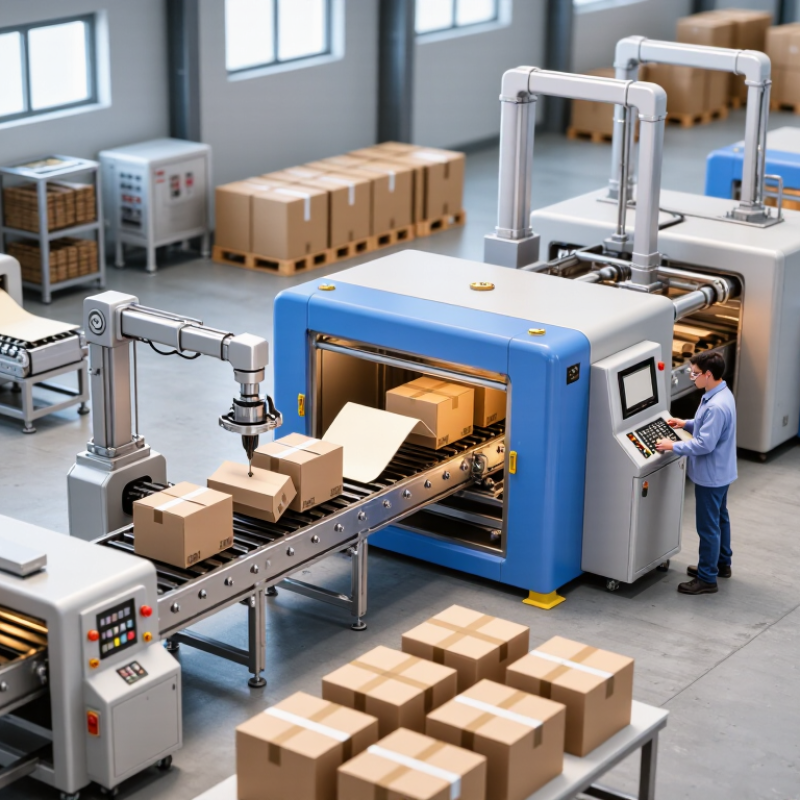
For 200–400 gsm board, machine choice depends on box geometry as much as paper weight. Flat blanks with straight walls usually run on automatic carton formers: a feeder positions each blank, then creasing, folding, and gluing create the shape. Round or tapered food containers need a different setup, commonly using a fan-shaped blank, a sealed side seam, and a formed bottom. Check whether the machine handles your board’s grain direction and coating. Small differences matter.
Heavier board needs firm, even creases; otherwise corners can crack or spring open. Operators should test the actual blank, not just a nominal gsm sample. FAO’s Global Forest Products Facts and Figures 2022 reports about 401 million tonnes of global paper and paperboard production, while the US EPA’s 2018 materials report records 41.9 million short tons of paper and paperboard packaging generated in the United States. These figures show the scale of the material stream, but they do not prove that one forming method suits every box. That matters. A practical trial should measure feed stability, seam strength, and finished-box dimensions at production speed. There is no perfect setting. Even a well-tuned machine may need adjustment when board stiffness or moisture changes.
Which Is the Best Paper Food Box Machine in China? - Paper Food Box Machine Types and Forming Methods for 200–400 gsm Board
| Machine Type | Forming Method | Typical Board Range | Suitable Box or Container Styles | Key Advantages | Points to Check |
|---|---|---|---|---|---|
| Automatic paper lunch box or tray forming machine | Feeds pre-cut, creased blanks into forming tooling. Folding fingers or forming dies raise the walls; seams are secured by the machine’s specified heat-sealing, ultrasonic, or adhesive system. | Often configured for approximately 200–400 gsm board; the usable range depends on board stiffness, coating, blank size, and tooling. | Rectangular meal trays, takeaway lunch boxes, and some food containers with tuck or formed corners. | Designed for repeated production of a defined container shape; can combine blank feeding, forming, and sealing in one line. | Confirm the sealing method is compatible with the board’s coating and food-contact construction. Check that the machine supports the required blank dimensions and corner design. |
| Single-station or semi-automatic box forming machine | An operator positions a pre-cut blank, then a pneumatic, hydraulic, or mechanical press forms it against a matched die. Sealing may be performed during forming or as a separate step. | May handle selected boards within 200–400 gsm; confirm the specific material and thickness limits with a production trial. | Short runs of trays, takeaway boxes, and specialty food packs with relatively simple shapes. | Typically offers a simpler setup and can be suitable for sampling, smaller batches, or product changes. | Output depends on operator handling and cycle time. Verify guarding, changeover requirements, die availability, and whether sealing equipment is included. |
| Automatic folder-gluer for food cartons | Folds pre-creased, die-cut carton blanks along their score lines and applies adhesive to specified seams. The finished cartons are usually delivered flat for later erection and filling. | Many carton folder-gluers can be configured for paperboard in or near the 200–400 gsm range, subject to the machine’s specification and board characteristics. | Folding cartons, sleeves, and tuck-style food boxes that are designed to be glued and shipped flat. | Suitable for carton designs made from accurately die-cut and creased blanks; integrates well with conventional carton converting workflows. | It does not generally form a rigid tray from a flat blank using a matched forming mold. Check carton layout, grain direction, glue type, and minimum blank size. |
| Automatic paper bowl or round-container forming machine | Forms a round sidewall from a shaped blank, joins the seam, and curls or crimps the bottom into place. Sealing and heating arrangements vary by machine design. | Material ranges are machine-specific; some models may accommodate board within 200–400 gsm, but round-container stock and coatings must be validated. | Round bowls and similar containers; generally not intended for rectangular food boxes. | A purpose-built option when the product is a round bowl rather than a rectangular tray or folding carton. | Check compatibility with the required bowl diameter, sidewall height, bottom stock, coating, and leak-resistance requirements. |
| Multi-station or servo-controlled tray forming machine | Transfers blanks through successive stations for positioning, folding, pressing, and seam sealing. Servo control can support repeatable motion and adjustable settings on compatible models. | May be specified for selected 200–400 gsm board grades; actual compatibility depends on tooling, stiffness, coating, and blank geometry. | Higher-volume production of repeatable rectangular trays or boxes, where the machine format matches the product range. | Can automate several forming steps and reduce manual handling compared with a single-station setup. | Compare supported formats, changeover time, control features, sealing method, and service requirements. Servo control alone does not guarantee suitability for every board grade. |
Selection note: There is no universally best machine. Choose by box style, required production volume, blank dimensions, sealing method, and tested material compatibility. Grammage (gsm) alone is not enough to predict formability: board thickness, stiffness, grain direction, moisture, and coating also affect the result. Request a trial using the actual 200–400 gsm board and production blank before purchase.