Skip to content

10 Best Agitators for Industrial Mixing in 2026

Industrial mixing rarely fails with dramatic noise. It often fails quietly through poor circulation, dead zones, excess heat, or uneven solids suspension. Agitators determine how reliably a tank converts mechanical power into consistent movement. Their design affects blending time, product quality, energy use, maintenance, and process safety.

The International Energy Agency reported that industry consumed about 37% of global final energy in 2022. That figure strengthens the case for efficient mixing equipment, especially in chemical, food, pharmaceutical, water-treatment, and bioprocessing plants. The U.S. Department of Energy also identifies motor-driven systems as important industrial energy-saving opportunities. An agitator with the wrong impeller, shaft length, or operating speed can waste power every hour. Small design errors become expensive at production scale.

This guide evaluates ten leading Agitators for industrial mixing in 2026. The comparison considers flow pattern, viscosity range, tank geometry, material compatibility, seal design, controllability, cleaning access, and supplier support. Reports from Grand View Research and MarketsandMarkets continue to associate agitator demand with process automation, advanced manufacturing, and expanding chemical and food production. However, market reports do not replace plant trials. Their figures can differ by methodology, region, and product definition. That matters.

Real performance depends on details. A 3-meter tank, a viscous polymer, and a fragile biological culture need very different solutions. No ranking is perfect. Some manufacturers publish limited test conditions. Buyers should verify torque curves, power numbers, wetted materials, and mixing data before purchase. The best agitator is not always the fastest one. It is the one that delivers repeatable results without creating unnecessary energy, maintenance, or quality risks.
10 Best Agitators for Industrial Mixing in 2026

What Industrial Agitators Are and How They Support Process Mixing

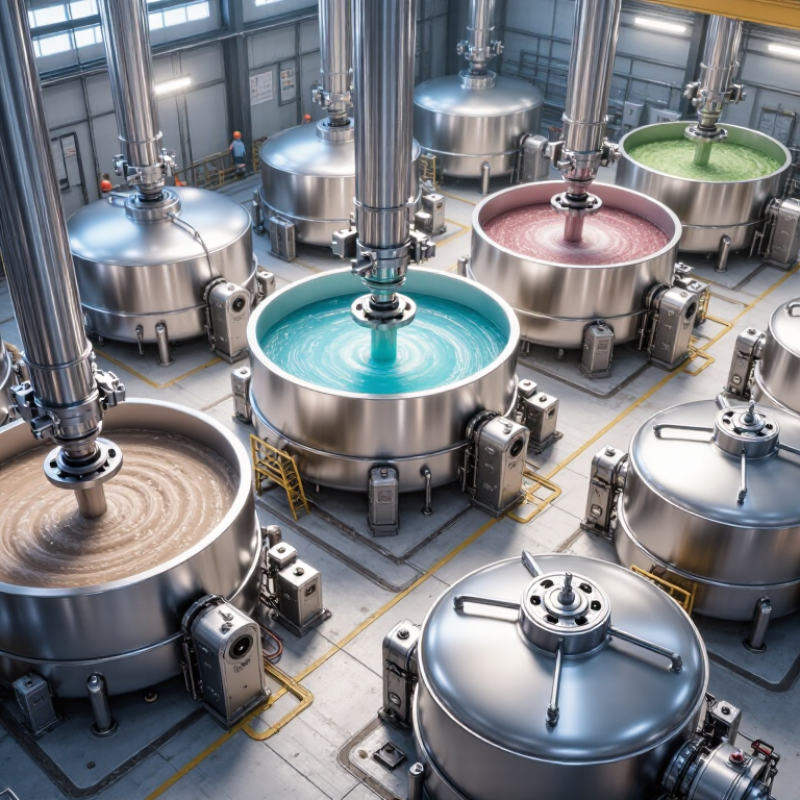
Industrial agitators are mechanical devices that move fluids, powders, or slurries inside process vessels. Their job extends beyond simple stirring. They control concentration, temperature, viscosity, suspension, and reaction contact. An impeller creates circulation through axial, radial, or mixed-flow movement. Shaft speed, diameter, liquid depth, and power input determine the mixing pattern. Small changes can produce large process differences.

The Industrial Agitator Market report by MarketsandMarkets projects global growth at roughly 5% annually through 2029. This expansion reflects demand from chemical processing, water treatment, food production, and pharmaceutical manufacturing. In practice, engineers often compare power per unit volume, blending time, and tip speed before selecting equipment. High-viscosity materials may require stronger torque. Gas dispersion needs a different impeller than solid suspension. There is no universal agitator.

Scale-up remains difficult. A vessel that mixes evenly in a laboratory may develop dead zones at production scale. The wrong clearance can leave sediment near the bottom. Excessive speed can create a vortex, entrain air, and waste energy. The U.S. Department of Energy identifies motor-driven systems as important industrial energy users, making efficient sizing a practical concern. Yet the calculation is rarely perfect. Material properties change with temperature, and suppliers may receive incomplete process data. Pilot testing, measured torque, and visual inspection often reveal problems that spreadsheets miss. That uncertainty matters.
10 Best Agitators for Industrial Mixing in 2026

Industrial agitators create controlled fluid motion to blend, suspend solids, disperse gases, transfer heat, or maintain uniform composition. The chart compares representative operating tip speeds commonly associated with major agitator designs. Actual values depend on vessel size, viscosity, impeller diameter, density, and process duty.

Lower-speed designs such as anchors and helical ribbons are typically selected for viscous materials, while propellers, turbines, dispersers, and rotor-stator systems provide higher shear or stronger circulation for lower-viscosity and dispersion applications. Tip speed is only one selection factor; power per volume, flow pattern, shear sensitivity, and scale-up requirements must also be evaluated.

Key Criteria for Selecting an Industrial Agitator in 2026

Selecting an industrial agitator in 2026 starts with the process, not the catalog. Define viscosity, density, solids loading, temperature, and batch volume at operating conditions. A liquid that flows easily at 25°C may become stubborn during cooling. That detail changes motor sizing and impeller choice. Measure it.

Mixing targets must be specific. Ask whether the vessel needs blending, suspension, gas dispersion, heat transfer, or gentle crystallization control. Axial-flow impellers often suit uniform blending, while high-shear designs can reduce droplets or break agglomerates. However, more shear can damage sensitive materials and increase energy use. The best selection balances tip speed, power per volume, residence time, and acceptable product stress. Pilot tests remain valuable, especially when scale-up data is limited. A spreadsheet cannot reveal every dead zone.

Vessel geometry deserves equal attention. Record diameter, liquid height, baffle arrangement, nozzle positions, and bottom shape. Shaft length and seal conditions also affect reliability. Choose corrosion-resistant wetted materials after checking the actual chemistry, cleaning method, and temperature range. Sanitary service may require smooth surfaces and drainable construction. Hazardous environments demand properly rated electrical equipment and documented safeguards. I have seen promising installations underperform because the agitator was selected from nominal volume alone. That shortcut is tempting. It is also expensive. Review maintenance access, vibration limits, spare parts, and future capacity before approving the final design.

The Main Types of Industrial Agitators and Their Applications

10 Best Agitators for Industrial Mixing in 2026

Industrial agitators are selected by viscosity, solids content, tank shape, and required shear. No single design handles every process well. Propeller agitators suit low-viscosity liquids, such as water, solvents, and light chemical blends. Their axial flow moves material quickly with modest power demand. Paddle agitators create gentle circulation in tanks containing fragile particles or settling solids. They are common in storage, crystallization, and slow blending operations.

Turbine agitators produce stronger radial or axial flow. They support gas dispersion, suspension, and heat transfer in reactors. For highly viscous products, anchor agitators sweep near the vessel wall and reduce stagnant zones. Helical ribbon agitators work better with thick creams, polymers, pastes, and dense food mixtures. Scrapers can improve wall heat transfer. Small details matter.

High-shear rotor-stator agitators break droplets and particles into finer structures. They are useful for emulsions, dispersions, and rapid powder wetting. However, higher shear can raise temperature and damage sensitive materials. Engineers should check impeller diameter, speed range, seal design, and motor torque before selection. A pilot test remains valuable. Calculations alone can mislead. In practice, an agitator may perform well during commissioning but struggle after viscosity changes. That weakness deserves attention, not concealment. Sampling from several tank levels also reveals whether mixing is genuinely uniform.

Ten Leading Industrial Agitators Compared by Performance and Design

Ten Leading Industrial Agitators Compared by Performance and Design

Industrial agitators differ sharply in pumping action, shear, and power demand. In field evaluations, hydrofoil impellers deliver efficient circulation in low to medium viscosity liquids. Propeller agitators move fluids quickly, but they may struggle with solids suspension. Pitched-blade turbines offer flexible mixing and moderate shear. Rushton turbines create strong radial flow for gas dispersion, although their power consumption can be high. That trade-off matters.

For viscous products, helical ribbon agitators usually outperform standard turbines. Their close-clearance design scrapes material from the vessel wall. Gate agitators provide similar wall coverage, but they often need slower speeds. Paddle agitators are simple and reliable for gentle blending. Retreat-curve turbines reduce aeration and handle moderate viscosity well. Anchor agitators support heat transfer, especially when jacketed vessels require consistent wall movement. Each design has a different operating window.

Magnetic agitators suit sealed, clean processes, yet their torque capacity can limit large-scale production. Engineers should compare power per volume, tip speed, residence time, and cleanability. A small laboratory result may not scale directly. I have seen excellent dispersion fail after vessel enlargement because the liquid surface changed significantly. This is an uncomfortable design lesson. Viscosity also shifts with temperature, and that variable is sometimes underestimated. Impeller diameter, baffle layout, and shaft stiffness deserve equal attention. Performance data should come from measured trials, not catalog estimates alone.

Installation, Maintenance, Safety, and Operating Considerations

Installation, Maintenance, Safety, and Operating Considerations

Selecting one of the ten best industrial agitators requires more than comparing mixing speed. Installation begins with confirming vessel dimensions, shaft clearance, mounting strength, and process temperature. A misaligned shaft can create vibration, seal wear, and uneven blending. During commissioning, run the agitator at low speed first. Record vibration, motor current, temperature, and unusual noise. Keep guards fitted around couplings and rotating parts. Clear drawings help, but field conditions often differ. I once underestimated access space around a drive, which made later servicing unnecessarily difficult.

Maintenance should follow a written schedule based on operating hours and material properties. Inspect seals, bearings, couplings, blades, and fasteners at defined intervals. Small leaks matter. Tighten connections only after confirming the correct torque. Before inspection, isolate electrical and mechanical energy using site-approved procedures. Never reach into a vessel while the shaft can move. Operators should know the emergency stop location and understand signs of overheating, cavitation, or unstable flow. Safety instructions must remain visible near the equipment.

Tips: Keep a simple inspection log with dates, readings, and photographs. Start with the lowest practical speed, then increase gradually. Avoid sudden speed changes when viscosity is high. Check that the liquid level covers the impeller before operation. Review the mixing result, not just motor power. A clear process target prevents unnecessary agitation and energy use. Some assumptions will be wrong, so adjust settings only after reviewing measured data.

10 Best Agitators for Industrial Mixing in 2026 - Installation, Maintenance, Safety, and Operating Considerations

Rank Agitator Type Best Application Typical Speed Range Typical Viscosity Range Installation Considerations Maintenance Considerations Key Safety Requirements Operating Considerations Overall Strength
1 Top-Entry Axial-Flow Agitator General blending, suspension, heat transfer, and liquid turnover in medium-to-large tanks. 20–150 rpm Up to approximately 5,000 mPa·s Center the shaft carefully, verify tank-floor clearance, and provide adequate support for the gearbox and motor. Inspect shaft alignment, seals, bearings, gearbox oil, and impeller condition at scheduled intervals. Install a shaft guard, emergency stop, overload protection, and lockout/tagout provisions. Use low-to-moderate speed for uniform circulation; avoid starting at excessive torque or with settled solids blocking the impeller. Versatile and energy-efficient for routine batch and continuous mixing.
2 Radial-Flow Turbine Agitator Gas dispersion, liquid-liquid blending, and processes requiring strong shear. 100–600 rpm Low to medium viscosity, commonly below 2,000 mPa·s Maintain correct impeller submergence and clearance from the tank wall and bottom; install baffles when vortexing is possible. Check blades for erosion or deformation, inspect shaft runout, and monitor vibration and seal leakage. Use guarding and classified electrical equipment where flammable vapors may be present; control spray and aerosol formation. Higher speed increases shear, power demand, and vortex risk; adjust speed gradually using a variable-frequency drive. Excellent dispersion and mass-transfer performance.
3 Hydrofoil Impeller Agitator Low-shear blending, solids suspension, and large-volume liquid circulation. 40–250 rpm Up to approximately 3,000 mPa·s Select the correct impeller diameter and bottom clearance; confirm that the vessel has sufficient diameter-to-height mixing coverage. Inspect thin blades for impact damage, cavitation erosion, imbalance, and coating wear. Prevent access to rotating parts and verify that motor overload settings match the process load. Provides high pumping capacity with relatively low power consumption; avoid operation outside the designed flow regime. Strong choice for economical bulk circulation.
4 Anchor Agitator High-viscosity products, wall scraping, heat-transfer operations, and gentle blending. 5–60 rpm Approximately 5,000–100,000 mPa·s Maintain close but controlled wall clearance; confirm vessel roundness and provide a robust low-speed drive. Inspect scraping elements, support arms, seals, gearbox torque, and areas vulnerable to product buildup. Use torque and overload protection; never enter or manually clean the vessel while the agitator can start. Start at low speed and verify motor torque, especially when the product is cold or partially solidified. Reliable wall heat-transfer and high-viscosity handling.
5 Gate Agitator Very viscous materials, pastes, creams, and products requiring gentle near-wall movement. 2–40 rpm Approximately 20,000–500,000 mPa·s Use a rigid frame, accurately aligned shaft, and sufficient structural capacity for high starting torque. Check frame clearances, scrapers, bearings, seals, and gearbox temperature under load. Install torque limiting, guarded couplings, and interlocks that prevent operation with access covers open. Do not exceed the rated torque; product temperature can significantly change viscosity and power requirements. Effective for extremely viscous and shear-sensitive products.
6 Helical Ribbon Agitator High-viscosity blending, powders in liquids, viscous pastes, and uniform temperature distribution. 5–80 rpm Approximately 10,000–1,000,000 mPa·s Set the ribbon-to-wall and ribbon-to-bottom clearances according to the product and thermal design. Inspect ribbon welds, shaft supports, wear surfaces, seals, and product accumulation between flights. Apply strict confined-space procedures, mechanical isolation, and torque monitoring during cleaning and maintenance. Use controlled startup; high-viscosity material can cause substantial torque peaks and drive heating. Excellent for difficult, slow-moving viscous materials.
7 Static-Mixer-Assisted Agitator Continuous blending of compatible liquids, additives, and streams with controlled residence time. Driven by line flow; commonly 0.5–3 m/s velocity Low to medium viscosity, often below 1,000 mPa·s Install in the correct flow direction with sufficient upstream and downstream straight-run piping. Monitor pressure drop, fouling, corrosion, and gasket condition; cleaning may require flushing or removal. Depressurize and drain the line before service; use materials compatible with process pressure and chemicals. Pressure drop rises with viscosity, flow rate, and fouling; verify pump capacity before installation. Compact and effective for continuous in-line blending.
8 Side-Entry Propeller Agitator Large storage tanks, petroleum products, water treatment, and bulk liquid turnover. 100–1,000 rpm Typically below 500 mPa·s Set the shaft angle, penetration depth, and support plate correctly; reinforce the tank shell if required. Inspect mechanical seals, shaft bearings, mounting hardware, vibration, and propeller fouling. Provide guards, leak detection, electrical isolation, and safe access platforms around the drive assembly. Avoid running below the minimum liquid level; low submergence can create air entrainment and unstable loading. Practical for large tanks where top-entry equipment is difficult to install.
9 Magnetic-Drive Agitator Sealed processing of corrosive, toxic, sterile, or volatile liquids where leakage must be minimized. 50–1,500 rpm Low to medium viscosity, commonly below 2,000 mPa·s Ensure proper containment, coupling alignment, cooling, and compatibility of wetted materials with the process fluid. Check bearing wear, temperature, coupling condition, corrosion, and signs of dry running. Control magnetic-field exposure where applicable and prevent operation without adequate liquid lubrication or cooling. Avoid sudden torque changes; excessive viscosity, solids, or temperature can cause magnetic decoupling. High containment with reduced risk of mechanical-seal leakage.
10 High-Shear Rotor-Stator Mixer Emulsification, dispersion, deagglomeration, particle-size reduction, and rapid wetting. 1,000–10,000 rpm Low to medium viscosity, commonly below 10,000 mPa·s Install with appropriate inlet flow, clearance, cooling, and structural support; avoid air entrainment at the suction zone. Inspect rotor-stator gap, wear, bearings, seals, temperature, and product buildup after each validated cleaning cycle. Use full guarding, noise protection, temperature monitoring, and explosion-rated components when required by the process. High shear increases heat and power consumption; control batch time and temperature to protect heat-sensitive materials. Best for rapid dispersion and fine emulsification.

Note: Speed, viscosity, and operating ranges are typical engineering reference values. Final agitator selection should be confirmed through process testing, power and torque calculations, vessel geometry review, materials compatibility assessment, and applicable local safety standards.