What Is the Best Copper Brazing Furnace in 2026?
Copper demand is rising, and reliable joining matters wherever thin tubes, fittings, or heat exchangers must hold pressure. The International Energy Agency’s Global Critical Minerals Outlook 2024 describes growing copper demand across energy-related applications. The U.S. Geological Survey’s Mineral Commodity Summaries 2025 also documents copper’s large, global supply chain. These reports explain the industrial context, but they do not identify one universally best furnace.
That choice depends on the actual joint. A 3 mm copper tube and a heavy manifold need different heating profiles, fixtures, and production rates. The AWS Brazing Handbook offers technical guidance on process variables, while equipment specifications should be checked against the alloys and filler metals in your production plan. Look closely at temperature uniformity, atmosphere control, usable work zone, loading method, and maintenance support. Small details matter. A furnace with impressive maximum capacity can still waste energy or produce uneven joints when routinely underfilled.
For 2026, the best Copper Brazing Furnace is not necessarily the newest or most expensive model. It is the one that repeatedly delivers sound joints at your required throughput, with manageable operating costs and documented process control. Ask suppliers for temperature-uniformity data, sample runs, and clear service terms. Then compare those claims with your own parts and inspection results. I would be cautious about rankings that ignore this step. Choosing from a brochure alone is tempting, but real production can expose gaps quickly.
What Is a Copper Brazing Furnace and How Does It Work?
What Is the Best Copper Brazing Furnace in 2026?
What Is a Copper Brazing Furnace and How Does It Work?
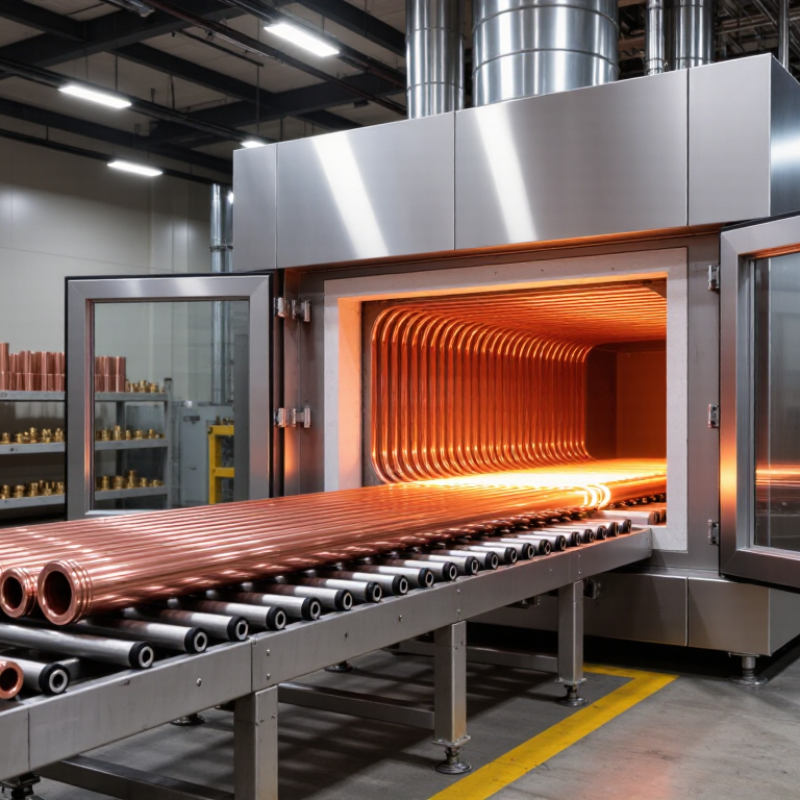
A copper brazing furnace heats copper parts and filler metal in a controlled environment. Unlike welding, brazing joins parts without melting their base metal. The filler melts, flows into the narrow joint, and bonds the surfaces as it cools. That flow depends on clean parts, a suitable joint gap, and steady heat.
The furnace may use resistance heating, induction, or another heating method. Temperature sensors help maintain the required heat cycle, while the chamber can use a controlled atmosphere to limit oxidation. In a typical cycle, parts are positioned in a fixture, heated evenly, held until the filler flows, then cooled. A small temperature variation can affect joint strength. Real setups are not always perfect; part thickness and fixture contact can create uneven heating, so trial runs and inspection matter.
Tips: Clean copper before loading, and keep joint surfaces aligned. Follow the filler metal’s recommended temperature range. Check the finished joint for gaps, discoloration, or incomplete flow. Don’t assume a shiny surface proves a strong bond.
Which Furnace Types Are Used for Copper Brazing?
Copper brazing uses several furnace types, and the right choice depends on part volume, joint design, and surface requirements. Batch controlled-atmosphere furnaces suit mixed production runs; operators can load fixtures and braze several assemblies together. Continuous mesh-belt furnaces keep parts moving through heating and cooling zones, making them practical for repeatable, high-volume work. Atmosphere control matters because copper oxide can interfere with wetting. Small details count.
Vacuum furnaces are often selected for clean joints and assemblies where flux residue is unwelcome, though their slower cycles and higher operating costs may not suit every shop. Induction systems heat targeted areas quickly, but coil design and part geometry can make temperature uniformity difficult. The U.S. Department of Energy’s 2022 Industrial Decarbonization Roadmap estimates that process heating accounts for about 51% of onsite energy use in U.S. manufacturing. That broad figure is not copper-specific, but it makes cycle efficiency worth measuring alongside joint quality. In practice, compare furnace temperature uniformity, atmosphere control, throughput, and actual energy use on representative parts; brochure ratings alone can mislead. A trial run may reveal the awkward exception.
What Factors Affect Furnace Performance and Joint Quality?
What Is the Best Copper Brazing Furnace in 2026?
Furnace performance is not just a peak-temperature number. Copper rapidly pulls heat away from a joint, so ramp rate, soak time, load size, and hot-zone uniformity all matter. For C11000 copper, the Copper Development Association reports thermal conductivity near 391 W/m·K at 20°C. That heat loss can leave a thick fitting underheated while a thin tube overheats. Small gaps matter.
The AWS Brazing Handbook identifies clean surfaces, suitable joint clearance, and correct filler-metal flow as key to reliable joints. Furnace atmosphere matters too: oxygen and moisture can promote oxide films that obstruct wetting. Keep fixtures consistent, place thermocouples near representative work, and validate the coldest load position. A glossy surface does not prove a sound joint. Routine process checks help, though variation between loads can still be missed.
Tips: Record actual part temperatures, not just controller readings. Check filler flow and joint coverage on sectioned samples. If results drift, inspect cleanliness, clearance, and atmosphere before raising the setpoint. More heat is not always the fix.
How Do Temperature, Atmosphere, and Throughput Guide Selection?
A copper brazing furnace should be chosen around the joint, not the headline temperature. The Copper Development Association reports thermal conductivity near 400 W/m·K for high-conductivity copper. Heat moves quickly through thin tube walls and into fixtures, so a slow or uneven ramp can leave joints underheated. AWS A3.0 defines brazing as using filler metal with a liquidus above 450°C, while keeping the base metals below their solidus. That margin matters.
Atmosphere selection depends on the copper surface, filler metal, and joint design. A controlled atmosphere can limit oxide formation, but moisture, leaks, and poor gas flow still undermine consistency. Check dew point and oxygen levels near the work zone, not only at the gas supply. AWS’s Brazing Handbook discusses controlled-atmosphere methods and their process requirements. A clean-looking inlet reading is not proof of a clean joint.
Throughput is more than parts per hour. Estimate hot-zone residence time from heated-zone length and belt speed, then confirm it with actual assemblies and production spacing. Track acceptable joints per hour, scrap, and temperature variation across the load. A compact furnace may appear efficient, yet crowded fixtures can shadow joints and slow recovery. This part is easy to underestimate. A short production trial often exposes assumptions that a specification sheet cannot.
What Should Buyers Compare in a Copper Brazing Furnace in 2026?
Compare furnace temperature uniformity before looking at headline capacity. Copper joints need enough heat to activate the brazing filler, but excess heat can distort thin walls or burn nearby components. Ask for temperature mapping across the usable zone, not just one sensor reading. A thermocouple placed near the center may miss cooler edges. Small details matter.
Next, match the furnace atmosphere and process style to the actual parts. Bright, clean copper often depends on controlled atmosphere quality, stable gas flow, and well-sealed doors or entry curtains. Review oxygen and moisture monitoring, plus how the system responds when doors open or production slows. On paper, this looks simple. In production, it rarely is. A conveyor furnace may suit steady, high-volume runs; a batch furnace can offer flexibility for mixed part sizes and frequent recipe changes. Neither is automatically better.
Ask suppliers for trials using your own assemblies, filler metal, and loading pattern. Check joint appearance, filler flow, cycle time, and distortion after cooling. Also compare usable work-zone dimensions, loading access, maintenance needs, and energy use under realistic conditions. A quoted rate may assume tightly packed parts and uninterrupted operation. That assumption deserves a hard look. Leave room for future part changes, but avoid paying for capacity your line cannot feed.